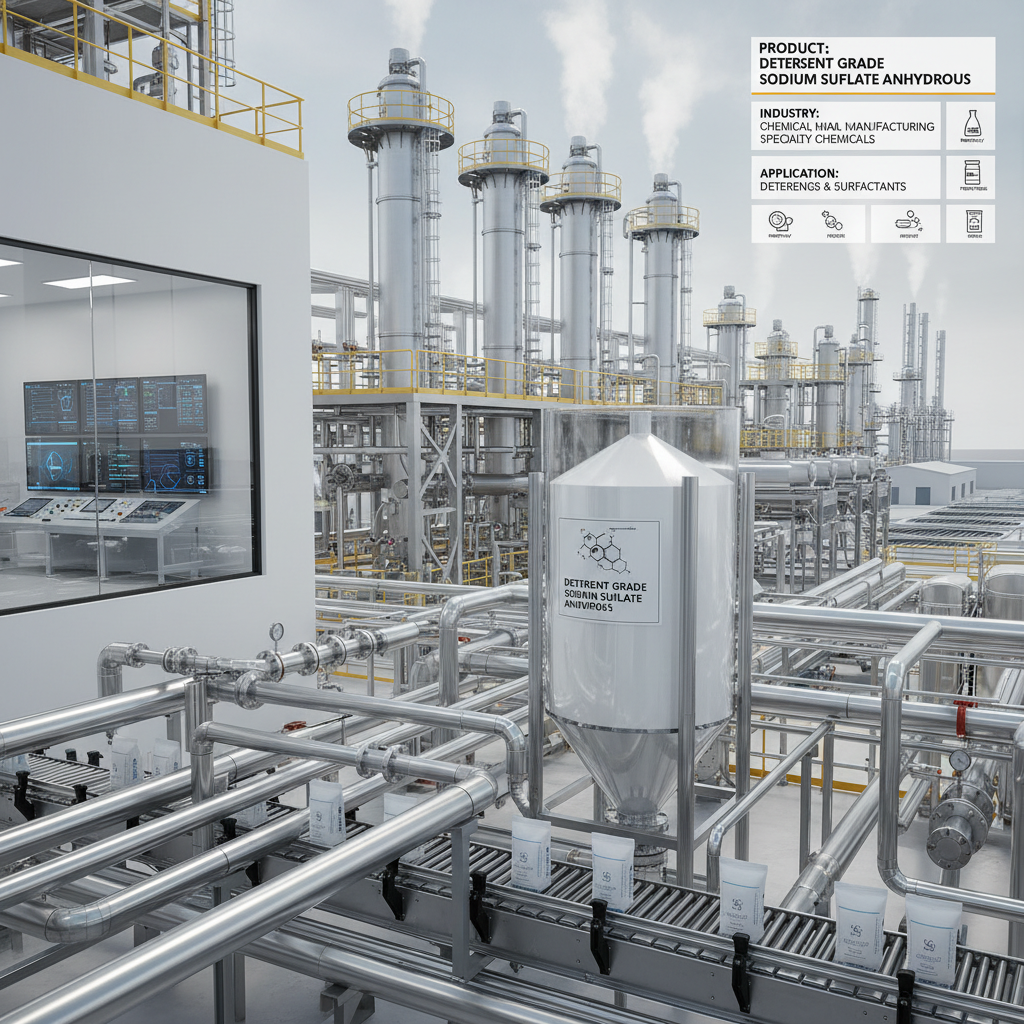
In the complex world of chemical manufacturing, Detergent Grade Sodium Sulfate Anhydrous serves as a fundamental pillar for the production of household and industrial cleaning agents. This inorganic compound is not merely a filler; it is a critical processing aid that ensures the stability, flowability, and consistency of powdered detergents, making it indispensable for manufacturers worldwide.
The global demand for high-purity Detergent Grade Sodium Sulfate Anhydrous is driven by the ever-growing hygiene standards and the expansion of the FMCG (Fast-Moving Consumer Goods) sector. By preventing the caking of active ingredients and assisting in the granulation process, this chemical ensures that the final product remains easy to dispense and highly effective in various water hardness levels.
Understanding the nuances of this material—from its anhydrous nature to its specific purity requirements—allows producers to optimize cost-efficiency without sacrificing quality. Whether used in premium laundry powders or heavy-duty industrial degreasers, the role of this compound is central to achieving a professional-grade cleaning finish.

Global Market Context of Detergent Grade Sodium Sulfate Anhydrous
The global chemical landscape relies heavily on Detergent Grade Sodium Sulfate Anhydrous to maintain the structural integrity of cleaning products. According to international trade data, the movement of this compound is closely tied to the growth of emerging economies in Asia and Africa, where the transition from traditional soap to powdered detergents has surged. The challenge for manufacturers remains the balance between sourcing high-purity crystals and maintaining a sustainable supply chain amid volatile raw material costs.
Furthermore, ISO standards for chemical purity ensure that these products do not introduce unwanted contaminants into the consumer's home. As global hygiene regulations tighten, the shift toward "detergent grade" specifications—which demand lower impurity levels than technical grade—has become a prerequisite for brands looking to maintain a reputation for safety and efficacy in the global market.
Defining the Specifications of Detergent Grade Sodium Sulfate Anhydrous
At its core, Detergent Grade Sodium Sulfate Anhydrous is a white, odorless crystalline powder that has been stripped of all water molecules. Unlike the decahydrate form, the anhydrous version is highly stable and does not clump when exposed to varying humidity levels, which is a critical requirement for the "pourability" of laundry powders.
From a technical standpoint, the "Detergent Grade" designation implies a high concentration of Na2SO4, typically exceeding 99%. This purity is essential because impurities like iron or heavy metals can cause discoloration in the final detergent product or interfere with the chemical action of surfactants, thereby reducing the overall cleaning power of the formula.
In the broader context of humanitarian and industrial needs, providing high-quality Detergent Grade Sodium Sulfate Anhydrous ensures that hygiene products can be manufactured locally in developing regions. This reduces the cost of importing finished goods and empowers local industries to produce affordable, effective cleaning agents for public health initiatives.
Core Functional Components and Chemical Stability
The primary role of Detergent Grade Sodium Sulfate Anhydrous is to act as a free-flowing agent. In a mixture of surfactants and builders, the anhydrous crystals act as physical spacers, preventing the surfactant molecules from agglomerating into a sticky mass. This ensures a consistent particle size distribution throughout the product.
Cost efficiency is another core component of using Detergent Grade Sodium Sulfate Anhydrous. By serving as a high-volume, low-cost filler that does not react negatively with other ingredients, it allows manufacturers to deliver a product that is easy to measure and dose without significantly increasing the price point for the end consumer.
Scalability in production is achieved through the chemical stability of the compound. Because it is non-reactive and possesses a high melting point, Detergent Grade Sodium Sulfate Anhydrous can be integrated into various spray-drying or granulation processes without the risk of chemical degradation or unplanned exothermic reactions.
Efficiency Metrics in Powdered Detergent Formulations
When analyzing the effectiveness of a formulation, the ratio of Detergent Grade Sodium Sulfate Anhydrous to active surfactants is key. A well-balanced formula ensures that the powder remains free-flowing even in tropical climates with high humidity, while still providing the necessary ionic strength to support the cleaning process.
The performance of these additives is often measured by their ability to maintain the structural integrity of the detergent granule. High-quality anhydrous salts provide a "skeleton" for the granule, preventing the collapse of the powder under the weight of stacked packaging during shipping and storage.
Performance Impact of Detergent Grade Sodium Sulfate Anhydrous Methods
Global Applications and Industrial Use Cases
Beyond household laundry powders, Detergent Grade Sodium Sulfate Anhydrous is extensively used in industrial cleaning sectors. In large-scale textile mills and paper processing plants, it is used to control the alkalinity and ionic strength of wash baths, ensuring that dyes and bleaching agents are distributed evenly across the fabric or pulp.
In regions such as Southeast Asia and Latin America, where local detergent manufacturing is a booming industry, the adoption of high-purity Detergent Grade Sodium Sulfate Anhydrous has allowed small-to-medium enterprises to compete with global conglomerates by producing stable, professional-grade products that withstand varied climatic conditions.
Long-Term Value and Sustainability Advantages
The long-term value of utilizing Detergent Grade Sodium Sulfate Anhydrous lies in its neutrality and reliability. Unlike some synthetic fillers, sodium sulfate is naturally occurring and, when processed correctly, presents minimal environmental toxicity. This makes it a preferred choice for companies moving toward "greener" chemical profiles.
From a logical and economic angle, the use of a stable anhydrous salt reduces waste. By preventing the caking and clumping of detergents in the warehouse, manufacturers avoid the financial loss associated with spoiled batches and rejected shipments, thereby enhancing the overall trust and reliability of the supply chain.
Moreover, the social impact of affordable detergent production cannot be overlooked. By optimizing the use of Detergent Grade Sodium Sulfate Anhydrous, brands can maintain lower price points for basic hygiene products, ensuring that dignity and cleanliness remain accessible to all socio-economic layers of society.
Future Innovations in Sodium Sulfate Processing
The future of Detergent Grade Sodium Sulfate Anhydrous is leaning toward "circular chemistry." Innovations in byproduct recovery—where sodium sulfate is captured from the production of other chemicals and purified back to detergent grade—are reducing the reliance on virgin mining and lowering the carbon footprint of the industry.
Digital transformation is also playing a role, with automated dosing systems in factories now using real-time sensors to adjust the concentration of Detergent Grade Sodium Sulfate Anhydrous based on the moisture content of other raw materials. This precision prevents over-filling and optimizes the product's performance.
As sustainability policies like the European Green Deal push for more biodegradable and less impactful ingredients, the focus is shifting toward the ultra-purification of sodium sulfate to eliminate any trace of heavy metals, ensuring that the "wash-off" from detergents does not negatively impact aquatic ecosystems.
Analysis of Detergent Grade Sodium Sulfate Anhydrous Specifications and Value
| Analysis Dimension |
Technical Parameter |
Industrial Impact |
Sustainability Score |
| Purity Level |
> 99.2% Na2SO4 |
Prevents discoloration |
9/10 |
| Water Content |
< 0.1% (Anhydrous) |
Eliminates caking |
10/10 |
| Particle Size |
Fine Powder / Granular |
Ensures flowability |
8/10 |
| Iron Impurity |
< 10 ppm |
Protects white fabrics |
9/10 |
| Solubility Rate |
Rapid in H2O |
Quick dissolution |
8/10 |
| Cost Efficiency |
Low per kg |
Optimizes MSRP |
7/10 |
FAQS
The anhydrous form contains no water of crystallization, which prevents the powder from clumping or "caking" in the packaging. In contrast, the decahydrate form can release water under certain temperatures, leading to a sticky consistency that ruins the flowability of powdered detergents.
While technically similar, technical grade may contain higher levels of impurities like iron or chlorides. In detergent production, these can cause the final product to yellow or react poorly with fragrances and surfactants, which is why the specific "Detergent Grade" is required for high-quality brands.
It does not provide the primary cleaning action (that is the role of surfactants), but it supports it by ensuring the active ingredients are evenly distributed and easy to dispense. It also helps maintain the ionic strength of the solution, which can improve the performance of certain builders.
Yes, sodium sulfate is a naturally occurring mineral salt. When used in detergents, it is generally considered low-impact and non-toxic to the environment. Modern production methods are further reducing its footprint by recycling byproduct streams from other industrial processes.
To maintain its anhydrous state, it should be stored in a cool, dry place in moisture-proof packaging. While it is more stable than the decahydrate, extreme humidity can still lead to surface moisture absorption over long periods.
The key is to ensure the supplier provides a comprehensive Certificate of Analysis (CoA) confirming the "Detergent Grade" purity. Using bulk bags (FIBCs) with inner liners is the most cost-effective way to ship large quantities while preventing moisture contamination during sea freight.
Conclusion
In summary, Detergent Grade Sodium Sulfate Anhydrous is far more than a simple additive; it is the structural foundation of the powdered detergent industry. By providing essential flowability, cost-efficiency, and chemical stability, it enables the mass production of hygiene products that are both effective and affordable. From its role in preventing caking to its contribution to global public health through accessible cleaning agents, its value is multifaceted and enduring.
Looking forward, the industry will likely see a shift toward even higher purity levels and a stronger emphasis on circular sourcing to meet global sustainability goals. For manufacturers, investing in high-grade anhydrous salts is a strategic move to ensure product consistency and consumer trust. To source premium chemical raw materials for your production line, visit our website: www.zjsles.com.